Core–shell gels
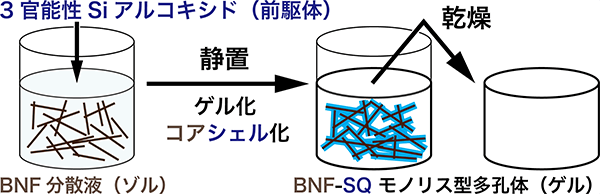
Adding a trifunctional silicon alkoxide, such as methyltrimethoxysilane (MTMS), to an aqueous acetic-acid dispersion of boehmite nanofibers (AlOOH; BNF) produces a monolithic porous material with a silsesquioxane composition. [1–2]
Many routes to monolithic porous materials control phase separation using additives such as surfactants or polymers. These additives must subsequently be washed out, and removal becomes more laborious for larger monoliths. During BNF–polymethylsilsesquioxane (PMSQ) gel formation, PMSQ coats the fiber surfaces while connecting the skeleton elements, producing a silsesquioxane skeleton containing the fibers. No dispersant or phase-separation inducer is required. Mixing two liquids initiates a single-step reaction. Whereas conventional preparation of PMSQ porous materials requires sequential acid- and base-catalyzed reactions, this route forms the structure using an acid catalyst alone.
The optical properties of BNF aerogels suggest that the fibers remain well dispersed until gelation. Electron microscopy also shows a spatially dispersed skeleton in core–shell gels. Increasing the amount of the fiber core increases the skeleton fraction and can reduce pore size, whereas increasing the PMSQ shell amount thickens the skeleton. Silicon alkoxides other than MTMS can provide other silsesquioxane shells. The gel is flexible under uniaxial compression and can be dried by evaporation while retaining its structure.
BNF-PMSQ gel can be prepared reproducibly by mixing a commercial BNF dispersion with MTMS. Few fabrication routes use the nanomaterial itself to control the porous structure. Other combinations of nanocolloids and polymers may extend this approach. Similar structures can also be prepared using dispersions of zirconia nanocolloids, including yttria-stabilized zirconia. [3]
Properties for applications
The thermal conductivity at atmospheric pressure is approximately 30 mW m⁻¹ K⁻¹. This value is not particularly low compared with commercial high-performance insulation, but weather resistance offers an advantage. Under low vacuum, the conductivity decreases to approximately 12 mW m⁻¹ K⁻¹, suggesting applications in simple vacuum insulation and specialized uses that benefit from low weight.
Structural optimization provides diffuse reflectors with reflectance exceeding that of Spectralon over 400–1200 nm. Together with their machinability, this property permits fabrication of optical devices. [4]
Machinability
BNF-PMSQ gels have higher mechanical strength and better machinability than porous materials of the same bulk density. CNC milling and wet polishing can produce features smaller than 100 μm, and the surface is strongly water-repellent. I am investigating applications including substrates for spheroid formation. [5–8]
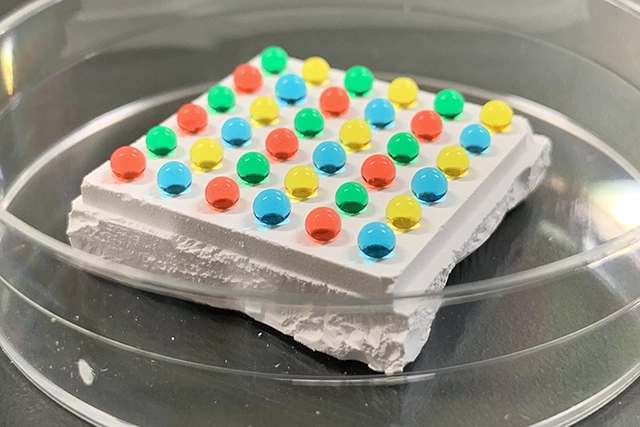
Uniaxial compression processing was also suggested to reduce thermal conductivity. [2]
Nanofiber-reinforced gels
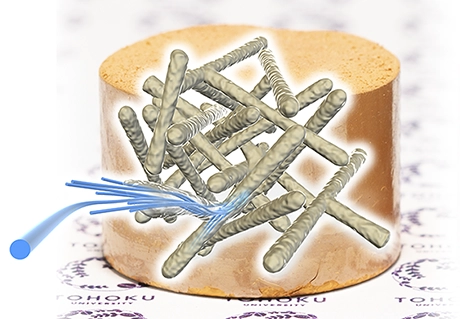
Boehmite nanofibers partition into the resorcinol–formaldehyde (RF) skeleton phase. Using this behavior, I prepared nanofiber-reinforced monolithic porous materials with fibers aligned within their skeletons. Few structures incorporate fibers into a skeleton only several tens of nanometers in diameter. This structure, together with a simple mixing-and-heating process, suggests possibilities for further development. [9]
The porous material was subjected to flame-resistance testing. Its flame-retardant behavior suggests potential applications in heat shielding at high temperature.
Publications
- Hayase, G; Nonomura, K.; Kanamori, K.; Maeno, A.; Kaji, H.;
Nakanishi, K. Boehmite Nanofiber–Polymethylsilsesquioxane Core–Shell Porous Monoliths for a Thermal Insulator under Low Vacuum Conditions. Chem. Mater. 2016, 28, 3237–3240.doi :10.1021/acs.chemmater.6b01010 (Accepted manuscript・ACS Articles on Request) - Hayase, G. Boehmite Nanofiber–Polymethylsilsesquioxane Composite Aerogels: Synthesis, Analysis, and Thermal Conductivity Control via Compression Processing. Bull. Chem. Soc. Jpn. 2021, 94, 70–75. doi:10.1246/bcsj.20200205 (Accepted manuscript)
- Hayase, G. Pseudoboehmite nanorod–
polymethylsilsesquioxane monoliths formed by colloidal gelation. J. Asian Ceram. Soc. 2019, 7, 469–475.
doi:10.1080/21870764.2019.1665766 (Open access) - Hayase, G. Boehmite Nanofiber–Polymethylsilsesquioxane Composite Macroporous Monoliths with High Diffuse Reflectance and Micromachinability. ACS Appl. Polym. Mater. 2025, 7, 10594–10600. doi:10.1021/acsapm.5c01749 (Open access)
- Hayase, G.; Yoshino, D. CNC-Milled Superhydrophobic Macroporous Monoliths for 3D Cell Culture. ACS Appl. Bio Mater. 2020, 3, 4747–4750.
doi:10.1021/acsabm.0c00719 (Accepted manuscript・ACS Articles on Request) - Iijima, Y.; Uenaka, N.; Morimoto, M.; Sato, D.; Hirose, S.; Sakitani, N.; Shinohara, M.; Funamoto, K.; Hayase, G.; Yoshino, D. Biological characterization of breast cancer spheroid formed by fast fabrication method. In vitro models 2024, 3, 19–32.
doi:10.1007/s44164-024-00066-3 (Preprint・ReadCube) - Kadotani, A.; Hayase, G.; Yoshino, D. Geometrically Engineered Organoid Units and Their Assembly for Pre-Construction of Organ Structures. APL Bioeng. 2024, 8, 046112.
doi:10.1063/5.0222866 (Open access) - Ito, K.; Iijima, Y.; Misumi, T.; Hayase, G.; Tamura, K.; Ikushima, K.; Yoshino, D. Biochemical State in Tissue Can Be Detected through Ultrasound Signal. npj Biomed. Innov. 2025, 2, 18.
doi:10.1038/s44385-025-00026-w (Open access) - Hayase, G. Fabrication of Boehmite Nanofiber Internally-Reinforced Resorcinol-Formaldehyde Macroporous Monoliths for Heat/Flame Protection. ACS Appl.
Nano Mater. 2018, 1, 5989–5993.
doi:10.1021/acsanm.8b01518 (Accepted manuscript・ACS Articles on Request)